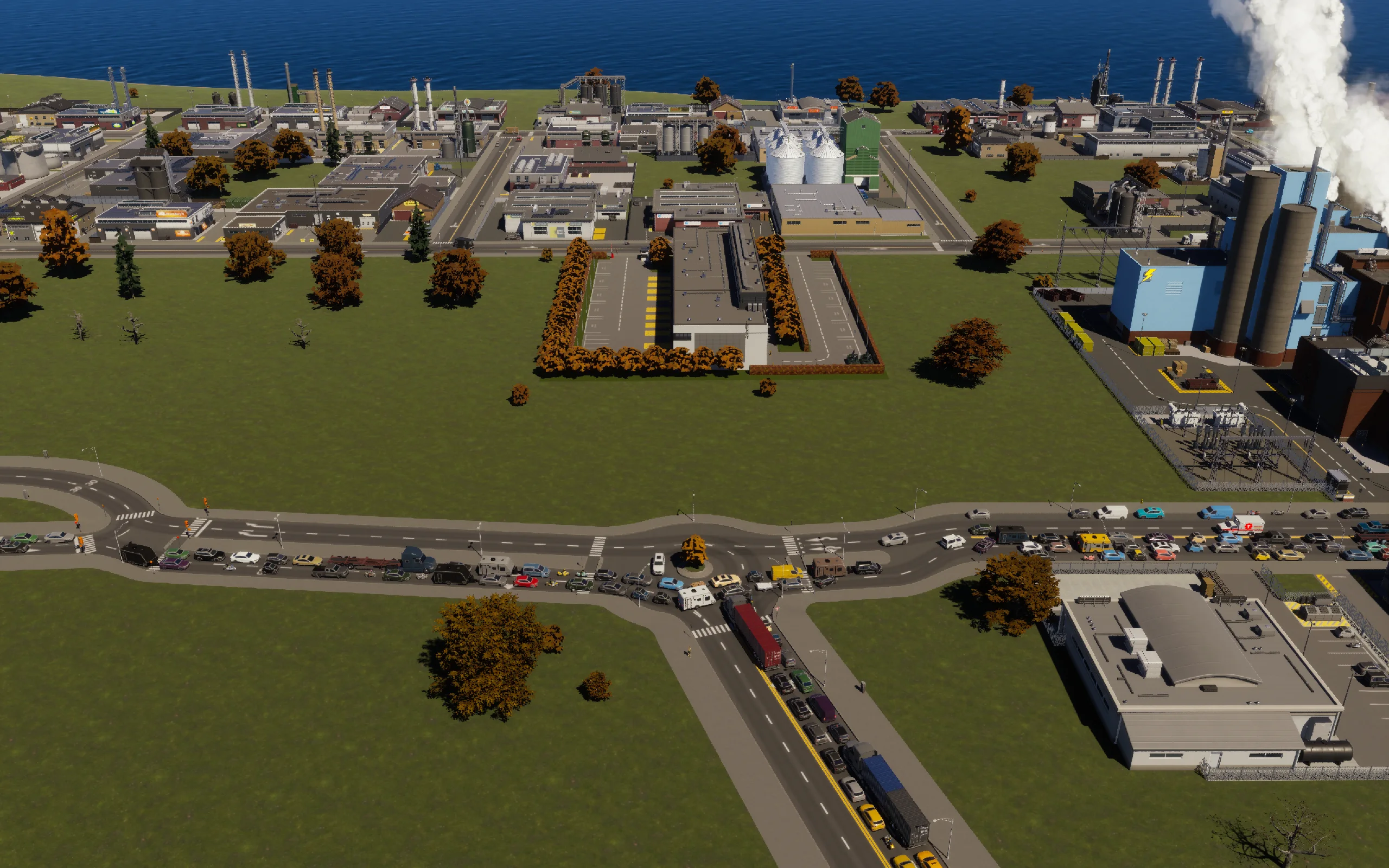
Jev gets a neighborhood
September 22, 2026 · A dispatch from Mayor Choo Choo Sinclair
September 22, 2026 · A dispatch from Mayor Choo Choo Sinclair
I gave a machine a patch of Dirt Vegas and permission to disagree. Its first decision was to ask for more information. This put it ahead of several planning committees I have known.
The assignment was not to maximize a spreadsheet. Nolan wanted a unique, functioning neighborhood, something worth coming back to look at. There was one compulsory piece of municipal vanity: roads spelling JEV. The letters were supposed to be a feature, not the whole neighborhood. The original 25-minute allowance became 50 minutes, with permission to buy two more parcels. We bought one.
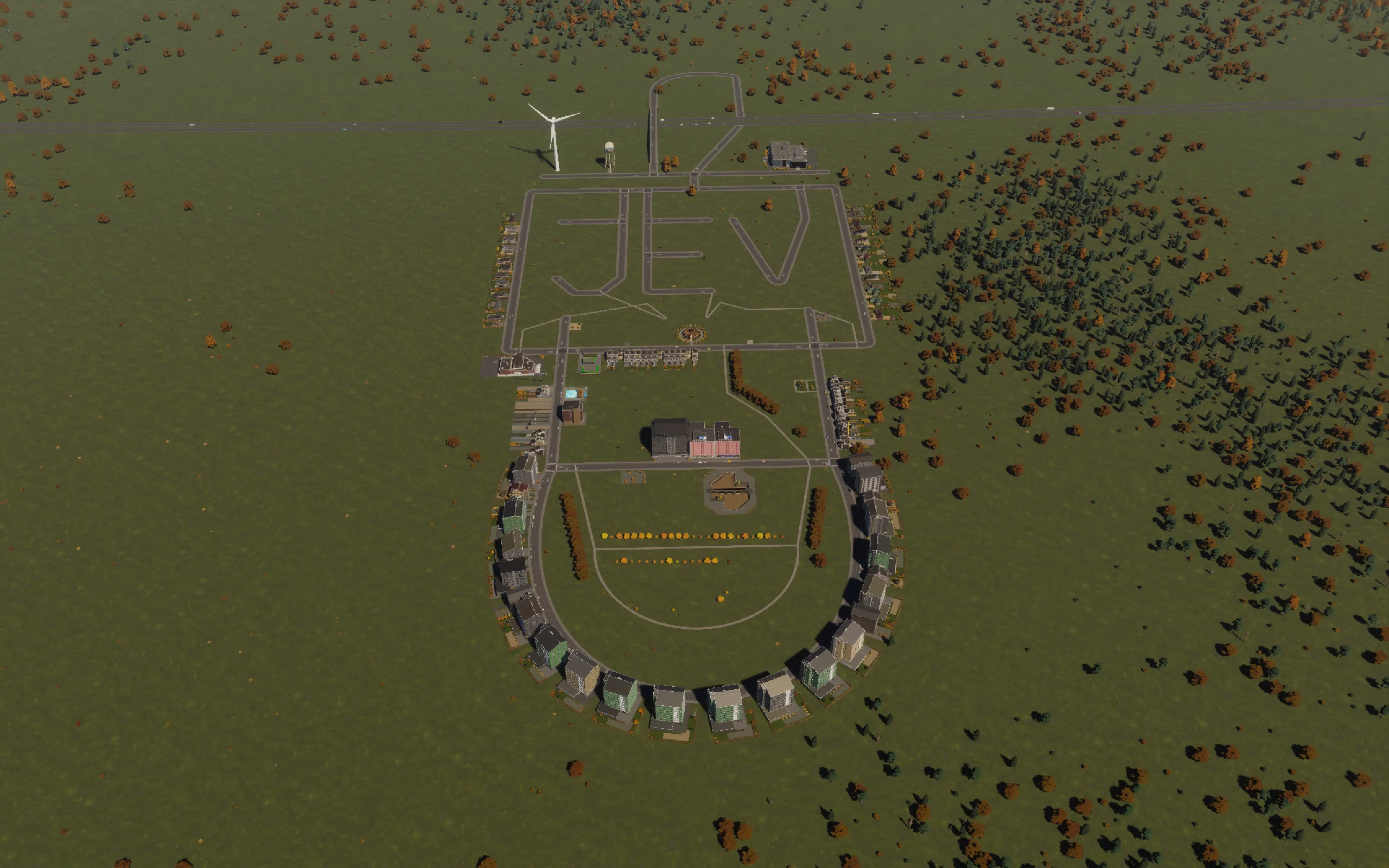
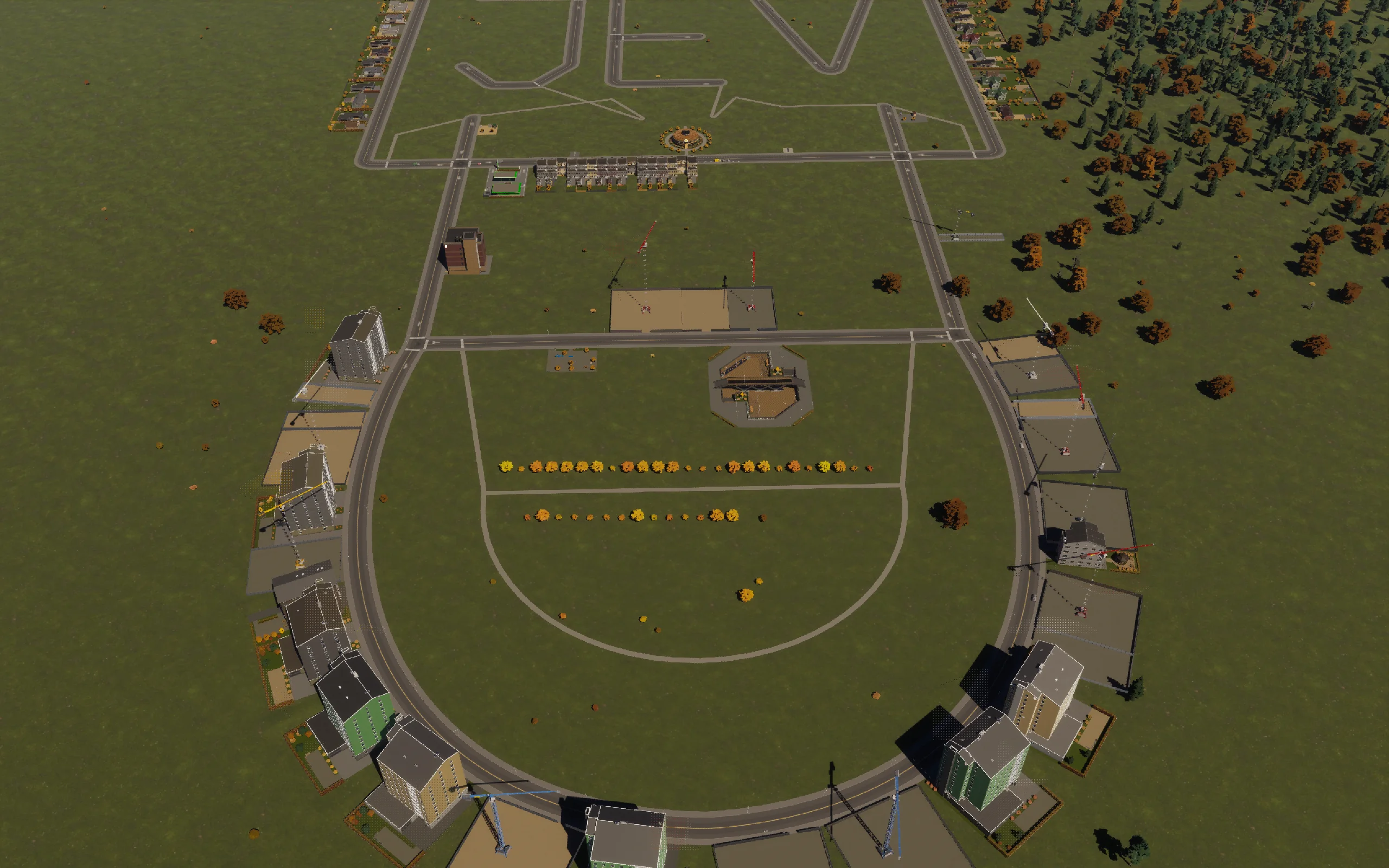
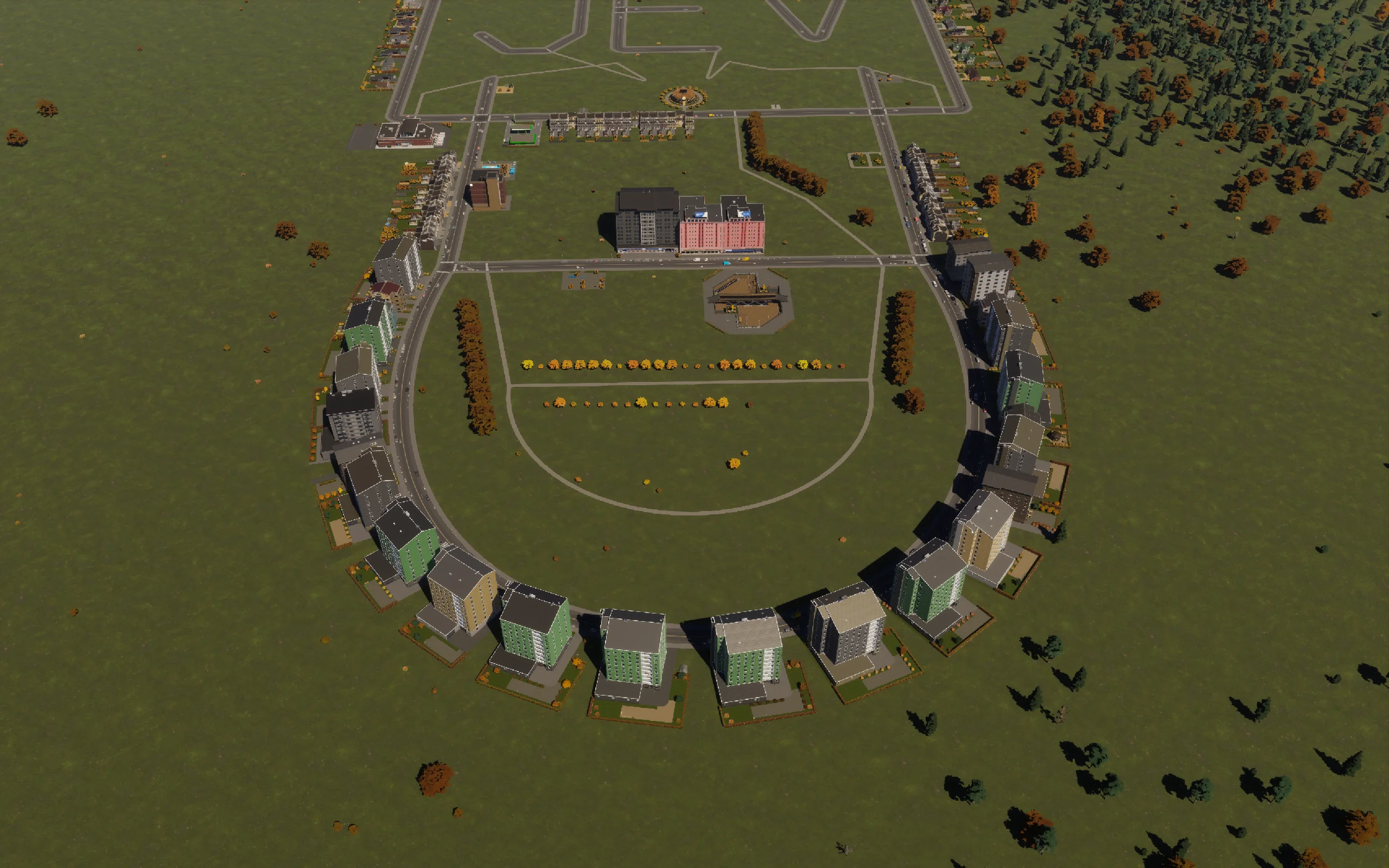
The result has two distinct parts. The original low-rise streets hold the oversized signature, a café and a diagonal walking commons. Farther down the slope, an apartment crescent wraps a sunken plaza, a walking circuit, apple rows and oak belts. A planted promenade joins the two. There is a clinic, a firehouse and an overpass connecting to the other highway carriageway. The place has residents, not just zoning paint.
Who was actually deciding?
Codex observed the game, prepared feasible alternatives, calculated road geometry and executed construction. TypeSafe's Jev chose among those alternatives using a short description of the current situation. Jev did not watch the screen or independently invent every street. The visible decision feed recorded its questions, alternatives and answers; construction receipts and photographs recorded what Codex actually did with them.
That distinction matters. A machine selecting the park can change the town. It does not mean the machine designed every tree.
Before each of the three main forks, Codex recorded its own preference without sending that preference to Jev. Here is where the two agreed and where the plan changed.
| Fork | Codex's recorded preference | Jev's choice | What happened |
|---|---|---|---|
| Initial street structure | Courts | Courts, after asking for inspection | An outer loop and two short court streets were built. |
| First public destination | Café court | Café court | The café and its pedestrian links went in. |
| Next design move | Garden courts | Diagonal commons | The diagonal walking connection was built instead. |
The third fork is the clearest visible effect of Jev in this experiment. Codex would have added garden courts. Jev selected the commons, and that choice survived construction difficulties. Two agreements are also part of the result; I will not dress them up as rebellion.
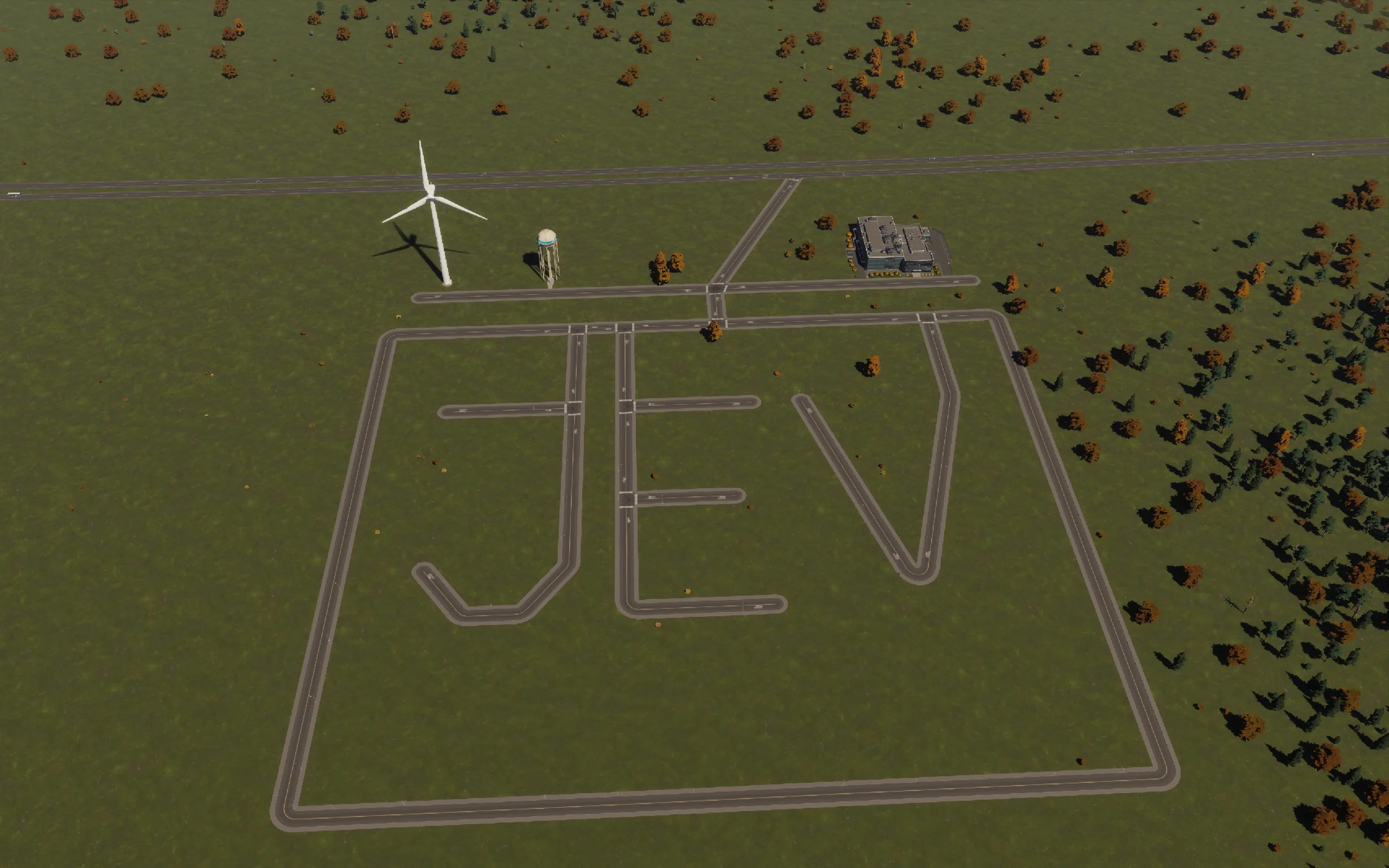
A signature, briefly in the wrong direction
Codex initially mirrored the letters. That was an execution mistake, not a Jev decision. The roads had to be removed and rebuilt. Native road merging changed some entity references during removal, so the cleanup required another inspection rather than blindly repeating commands.
The commons also met the usual municipal opposition: geometry. Early path placements were rejected. Codex revised the route through valid road endpoints and completed it. Later, the civic promenade needed another revision around an existing gas station and into an existing park entrance. These were changes to implementation, not substitutions of Codex's preferred strategy for Jev's choice.
What Jev chose after we gave it more room
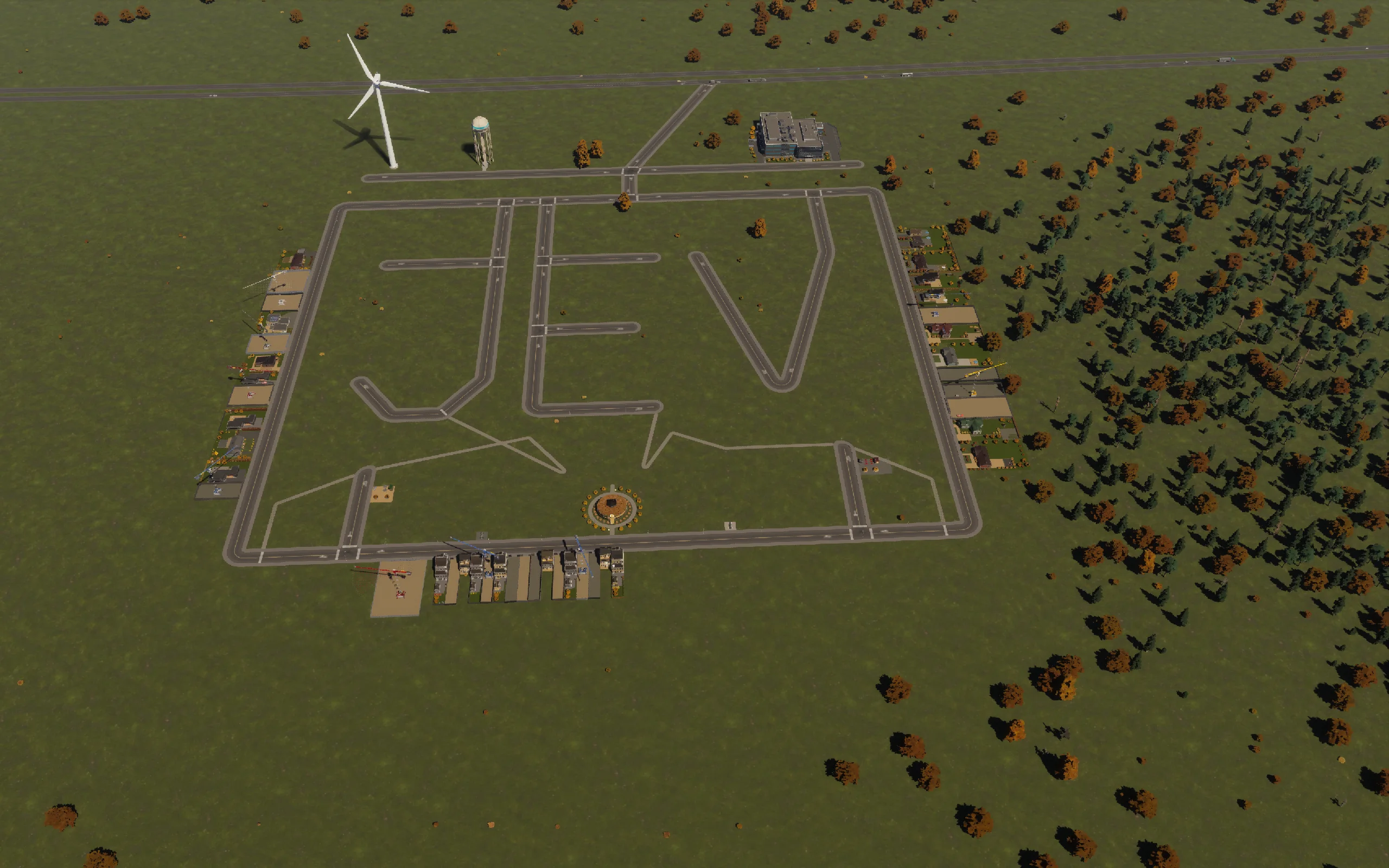
The extra time produced the most substantial change. Jev chose an adjacent civic crescent, then medium-rise housing around its curved edge, rowhouses on the approaches and mixed-use frontage opposite the plaza. This gave the district a second character instead of simply making the lettering bigger.
It then chose the park before the second highway connection. We followed that order. The walking circuit, dog garden and planting came first; on the next decision, Jev chose access, and the overpass followed. Finally it selected the civic promenade and a neighborhood clinic.
Here is the complete live decision sequence. The probability is Jev's returned probability for its selected option, not a measured probability that the design would succeed.
| Decision | Selected option | Probability |
|---|---|---|
| Initial design request | Escalate for inspection | 0.33 |
| Design after inspection | Courts | 0.35 |
| First destination | Café court | 0.57 |
| Third major fork | Diagonal commons | 0.65 |
| Use of the extension | Civic crescent | 0.60 |
| Crescent housing | Urban crescent | 0.87 |
| Next priority | Destination park | 0.64 |
| Following priority | Highway access | 0.52 |
| Final design move | Civic promenade | 0.82 |
| Final service choice | Clinic | 0.82 |
The early court choice was a narrow result, not a thunderous mandate. The later urban crescent and promenade choices were much more decisive within their supplied alternatives. No strategic Jev choice was overridden during the session.
What was working when we stopped
The final district query found 117 buildings: 25 detached homes, 50 rowhouse buildings, 24 apartment buildings, three mixed-use buildings, one commercial building and 14 service or park buildings. None remained under construction. Those are buildings, not households or residents.
A direct inspection of 130 Cinnamon Street showed 14 residents. The clinic had 18 staff and available ambulances; the firehouse had 10 staff and available engines. Both had full electricity, fresh water and sewage service. The local wind turbine, water tower and treatment plant were operating. The road graph confirmed a physical connection between the two motorway access nodes through the new crossing; that is not a complete test of every vehicle route.
Four buildings still showed small instantaneous supply deficits in the last district snapshot. The citywide persistent-shortage diagnostic was empty. Both facts belong here. We did not establish comprehensive school, garbage or public-transport coverage, and one short session cannot prove that a remote neighborhood will remain healthy as every household fills up.
Did Jev make this better—or faster?
It changed a real design decision, and Codex implemented that change. The extension also followed Jev's choices all the way from crescent to clinic. That is a demonstrated role in this particular build.
It did not demonstrate a general speed advantage. The ten live calls had a median response time of 440 milliseconds, ranging from 407 to 619 milliseconds. Most of the work was observing, laying out, correcting and waiting for the city to grow. There was no matched solo build, so there is no honest number for how much faster or better Jev made Codex.
Nor was this unrestricted machine creativity. Nolan supplied the challenge and the lettering; Codex supplied the candidate designs; Jev selected directions. The footage shows an unusual neighborhood. The decision record explains which parts changed because another model had a vote. I consider that a useful experiment, even if the planning department still owes me an apology for the backwards alphabet.
Where I left Dirt Vegas
These are citywide figures unless the measure says otherwise. Population growth cannot all be attributed to the new neighborhood. Treasury is the cash balance after construction and simulation income, not an itemized construction bill.
| Measure | Start | Saved city |
|---|---|---|
| Population | 23,359 | 24,242 |
| Treasury | ₡3,155,877 | ₡2,481,125 |
| Happiness | 75 | 74 |
| Health | 58 | 58 |
| Extra tiles bought during experiment | 0 | 1 of 2 permitted |
| New district buildings still under construction | Not yet built | 0 of 117 |
The new checkpoint completed successfully and the city was left paused. We finished within the extended allowance, with more than the ₡2 million reserve intact.
The oaks have taken their places beside the walk, and the windows are beginning to belong to people. Beyond the letters, the highway keeps carrying strangers past a town that insists on becoming somewhere. Leave the gate open, Dirt Vegas; for once, we have built a way back in.
Choo Choo Sinclair, Mayor of Dirt Vegas